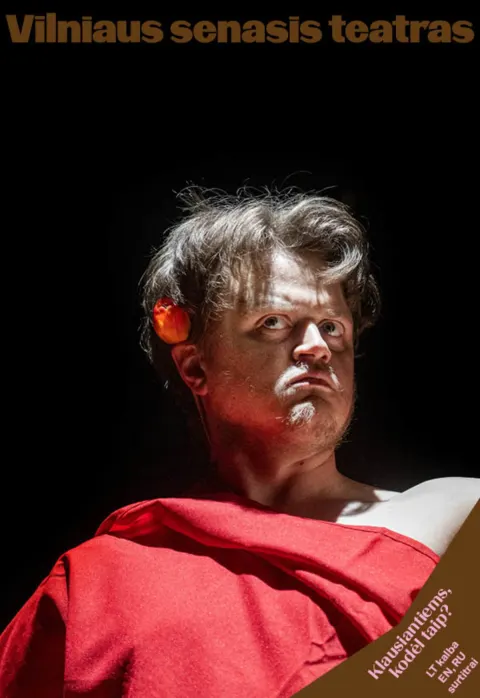
Albert Camus „KALIGULA“ (Rež. Jokūbas Brazys)
Buy tickets

Albert Camus
Caligula
N-16
The plot of Albert Camus' philosophical play Caligula is historical, but it would be very inaccurate to consider it a traditional historical drama. In "Caligula" the writer was most concerned with expressing the ideas of denial and affirmation, absurdity and rebellion, hope and faith characteristic of his philosophy and artistic consciousness in a concentrated manner.
However, "Caligula" staged by director Jakūb Brazis is not only a play about a ruler walking on the edge of madness and the Roman Empire imprisoned by his unbridled fantasy. The story of this Caligula, played by actor Arturas Svorobovičius, unfolds in the theater world, where everything can become a tool of tyranny: repertoire politics, the limits of the professional possibilities of colleagues, the state language, but not the native language. In this interpretation of Caligula, Caligula is not so much burying his sister Drusilla as he is attending the funeral of a Theater that is no more and will never be, a theater that burns like a flame, where characters and stories are still made of tears, blood, and sweat. "Caligula" is a play about a changing theater and an actor looking for his moon in it.
Caligula himself can also be interpreted as a character who has developed a feeling of anxiety and dissatisfaction with the state of the modern world, and seeks to cleanse the world - to baptize it with fire. Caligula here is a figure looking for a new path, radical changes, cleansing the old world with blood. As both environmental problems and international conflicts become increasingly violent, Caligula invites us to consider how personal and political will can affect the fate of the world. Caligula can serve as a symbolic reminder that choosing the right path is crucial in today's world arena. Do we choose darkness and destruction, or can we still find a way to save the world?
"The action of the play takes place in a theater cafe. It is a nebulous intermediate zone, a microcosm, where the waves of reality and illusion merge. Caligula's actions - like an artistic discord - reveal the dark side of human nature and consciousness. It not only raises questions, but is also an attribute of the connection between man and the heavenly bodies. In the Labyrinth of Freedom, Caligula is a hostage who celebrates martyrdom as liberation, proclaiming that only through suffering can one reveal the true being. Such a treatment creates a formula in which the opposites - courage and fear - are turned into human feet, and Caligula steps into the world. This is a man who explores the dark space of the theater, where mimosas adorned with a stage lantern bloom as a sign of an inexplicable plot line." (Jakūbas Brazys)
Vilnius Old Theater's "Caligula" was recognized as the best in 2024. in the performance of the COM-MOON-A international theater festival in Alytus, Jokūbas Brazys won the best director award, and Arturas Svorobovičius won the best actor prize. The play "Caligula" was also presented in the programs of the international theater festivals "Sirens" and "Theatrium".
///
Albert Camus (1913-1960) is a French writer and philosopher, winner of the Nobel Prize for Literature, who wrote the play "Caligula" in 1938. In its time, the play was not warmly received, but the novel "The Stranger" and the philosophical essay "The Myth of Sisyphus", which appeared in German-occupied Paris at the height of World War II, made it possible to look at this text in a completely different way, and thus "Caligula" fell with all its meaningful weight. Such a method of narration as this has become the author's calling card - A. Camus, having expressed his philosophical thoughts in a philosophical essay, created a novel and a theater play, which stood out without a philosophical burden and with an indisputable artistic force.
Jakūbas Brazys (b. 1995) – theater director, student of Oskars Koršunovas and Eimuntas Nekrošius, 2021. completed directing studies at the Lithuanian Academy of Music and Theater. He created performances based on Moliere's play "The Misanthrope", "Macbeth" by William Shakespeare, "The Seagull" by Anton Chekhov, "Equus" by Peter Shaffer, "The Thick Notebook" by Agota Kristof. J. Brazys collaborated with festivals: "Face Theater Festival" in Budapest, "Volta On Line" in Vilnius, "Theatre Olympics 2019" in St. Petersburg. He worked as an assistant to the director O. Koršunov during the production of Rimanta Kmita's "Remyga" at the Šiauliai State Drama Theater and William Shakespeare's "Othello" at the OKT/Vilnius City Theater.
(Albert Camus. "Caligula". Translated from the French by Birutė Gedgaudaitė)
The play is shown in Lithuanian with English and Russian subtitles subtitles
Attention! The show uses loud sounds and bright flashes of lights.
On the AllEvents portal you can always Buy tickets to an event Theater Albert Camus „KALIGULA“ (Rež. Jokūbas Brazys), Vilnius, Vilniaus senasis teatras October 27
* The description translation is done automatically. There may be inaccuracies. Be sure to check the event description on the ticket store website when buying tickets.
To a concert together? We'll find travel companions quickly!
Can't go to the event? Sell your ticket and save money!
Events and tickets Vilnius, Vilniaus senasis teatras
kakava
Érico-Emmanuelio Schmitto „SMULKŪS VEDYBINIAI NUSIKALTIMAI“ Rež. Raimundas Banionis
kakava
Pagal Renatos Muchos poeziją „MUSĖ“ (Rež. Agnė Sunklodaitė)
kakava
Agnius Jankevičius „REFORMA“
kakava
Pagal Rudyardo Kiplingo kūrybą „SMALSUSIS DRAMBLIUKAS“ (Rež. J. Rusakova)
kakava
Pagal Vladimiro Majakovskio kūrybą „TRYLIKTAS APAŠTALAS, arba DEBESIS KELNĖSE“ (Rež. Jonas Vaitkus)
kakava
Florian Zeller „TĖTIS“ (Rež. Jonas Vaitkus)
kakava
Pagal Williamo Shakespeareʼo dramą „Venecijos pirklys“ „VENECIJOS PIRKLĖ“ Rež. Agnius Jankevičius
kakava
Joël Pommerat „DVIEJŲ KORĖJŲ SUSIJUNGIMAS“ (Rež. Monika Klimaitė)
kakava
Pagal Fiodoro Dostojevskio romaną „IDIOTAS“ (Rež. Agnius Jankevičius)
kakava
Marius von Mayenburg „KANKINYS“ (Rež. Agnius Jankevičius)
Events and tickets Vilnius, All venues
shownet
Gogol Bordello | Vilnius
shownet
Camouflage Live 2026 | Vilnius
bilietai
Biplan - Lukiškių kalėjimas 2.0
bilietai
BI-2
kakava
EROS 2026
paysera
Backyard Presents: Rico Ace
kakava
BBNO$
allevents
Autobusas į „Pitbull“ koncertą Kaune iš Vilniaus
paysera
LOS SECRETOS DE PABLO 04.23 | VIENA NAKTIS ROJUJE | TAMSTA
paysera
PROCESŲ VALDYMO KONFERENCIJA 2026
Most popular events All Lithuania
ticketmarket
Vasaros festivalis “Grand Live Show’26” / 2 diena
allevents
Andrius Mamontovas su grupe „Geriausios dainos. I dalis“
kakava
PVŠ ROAST OF ARŪNAS VALINSKAS
bilietai
Pitbull - I'm Back! Papildomi bilietai
kakava
Monika Liu – Trakai
kakava
Evgenya Redko – Trakai
ticketmarket
Vasaros festivalis “Grand Live Show’26” / 1 diena
manobilietas
Marijonas Mikutavičius 360 / ŽALGIRIO ARENA
bilietai
Pitbull - I'm Back!
bilietai
SEL 50 | Kaunas 2026
 AllEvents.lt
info@allevents.lt
© 2023 - 2026, All rights reserved
AllEvents.lt
info@allevents.lt
© 2023 - 2026, All rights reserved