Marius Ivaškevičius „RUSIŠKAS ROMANAS“ (Rež. Oskaras Koršunovas)
Buy tickets

A two-part drama performance
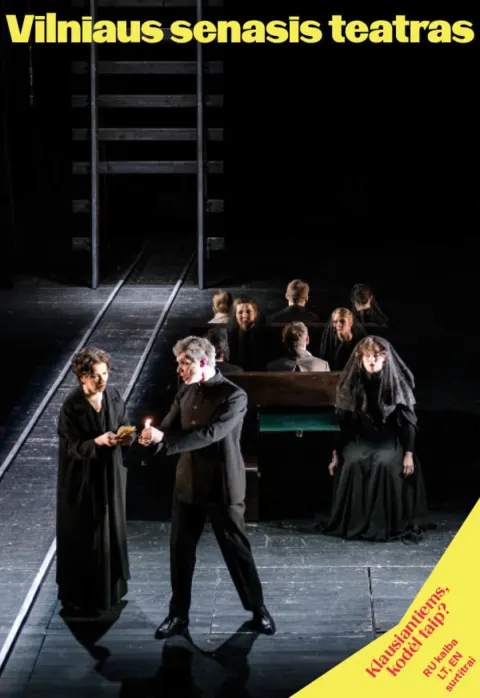
The play by the playwright Mariaus Ivaškevičius tells about the drama happening in the family of the writer Leo Tolstoy a few months before the writer's death. However, L. Tolstoy is neither in the play nor the performance. L. Tolstoy's wife Sofya Andreyevna became the main axis of this drama. In the play, a woman's love is passionate, reckless, inhuman, all creative and all destructive. The playwright and director saw and concentrated the traits of many of the writer's female characters (especially Anna Karenina) in the character of L. Tolstoy's wife. One of the main characters is Chertkov, who is a real historical person who became a friend of L. Tolstoy's family, gained the writer's unconditional trust, became his "man - secret weapon" and turned the writer's family life into hell in the last years of his life. On the train tracks, and indeed on the tracks of history, which become the basic image and metaphor in the play, there are cultural stereotypes, illusions, envy, the myth of genius, Russianness, which are crushed by the locomotive of history and today. According to O. Koršunov, "Russian Novel" is a multi-layered, multi-topical play that examines the intersections of creativity and real life, talks about femininity and what it means for a woman to live with a genius, and for a genius to live with a woman, analyzing political topics that become especially relevant when we are faced with the rising wave of the radical right in Europe. It should be added that when today's Russia becomes a fascist state. This greatly affects the context of the performance. In the context of Russia's war against Ukraine, geopolitical and political shifts, the performance acquired new meanings, became even more relevant and controversial. This play was written by M. Ivaškevičius in Russian, first staged in 2017. at the V. Mayakovsky Theater in Moscow, awarded the "Golden Mask" award as the best dramaturgy performed in Russia that year. Now that sounds almost ironic. Oskars Korshunovas (2018):
"The same thing happened with this play, as it always happens with Ivaškevich's dramaturgy: you begin to realize how good a play he has created only when you put it on the stage of the theater. It happened with his "Išvarymu" and it is the same now and here." After all, modern drama is not only what the playwright creates now. The real modern drama is that which is being created now, and which gives the impetus, dictates to our whole theater the example of a new stage language. It really exists in this play by Ivaškevich.”
Marius Ivaškevičius (March 2025):
"The time of conception of the play "Russian novel" coincided with the beginning of the Maidan revolution in Kyiv. Soon after, the annexation of Crimea happened, Russia started an undeclared war in Donbas, and I was plagued with dilemmas about whether I really wanted to write this play. After about half a year of reflection, I decided that such a piece might have meaning after all. That the late Leo Tolstoy - a pacifist and an opponent of any imperialism - could be a symbol of a different Russia. If monuments were erected to him, and not to Stalin and Kalashnikov, in the squares of Russian cities, Russia would be different today. While writing this play, I included many political references to Putin's authoritarian Russia, being sure that the audience will easily pick them up. One of them - about Moscow, where someone is killed every day - appeared as a reaction to the assassination of Boris Nemtsov. I was writing the finale of the play that deep night in the basement. After that I turned on the Internet and saw what just happened on the bridge near the Kremlin. For a couple of hours, I watched a live broadcast of people in Moscow gathering around the murdered Russian opposition leader. After that, I went down to the basement again and wrote the above phrase. I was surprised to see how in the numerous reviews that appeared after the premiere in Moscow, no one noticed my political allusions. Until one Russian theater blogger collected them all in a pile and published them on his platform. I thanked him, saying he was the only one who noticed them. To this he answered me: "Believe me, everyone sees and hears them, but they are afraid to write about it." Of course, today, seeing how fascism has won in Russia, my hopes that the play about L. Tolstoy can change something there seem naive. And if today I were asked if I would write it differently, I would answer: No.
I wouldn't write it at all. And not only her. in 2022 the beginning of the large-scale Russian invasion of Ukraine erased the meaning of many of the political plays I had written up to that point. And not just mine. Unfortunately, we are only writers, not prophets. We live and act in real time, not knowing what that time has in store for us."
///
We warn you that there is smoking on stage during the performance.
The show premiered in 2018. September 15
photo Laura Vansevičienės
On the AllEvents portal you can always Buy tickets to an event Theater Marius Ivaškevičius „RUSIŠKAS ROMANAS“ (Rež. Oskaras Koršunovas), Vilnius, Vilniaus senasis teatras October 31
* The description translation is done automatically. There may be inaccuracies. Be sure to check the event description on the ticket store website when buying tickets.
To a concert together? We'll find travel companions quickly!
Can't go to the event? Sell your ticket and save money!
Events and tickets Vilnius, Vilniaus senasis teatras
kakava
Érico-Emmanuelio Schmitto „SMULKŪS VEDYBINIAI NUSIKALTIMAI“ Rež. Raimundas Banionis
kakava
Pagal Renatos Muchos poeziją „MUSĖ“ (Rež. Agnė Sunklodaitė)
kakava
Agnius Jankevičius „REFORMA“
kakava
Pagal Rudyardo Kiplingo kūrybą „SMALSUSIS DRAMBLIUKAS“ (Rež. J. Rusakova)
kakava
Pagal Vladimiro Majakovskio kūrybą „TRYLIKTAS APAŠTALAS, arba DEBESIS KELNĖSE“ (Rež. Jonas Vaitkus)
kakava
Florian Zeller „TĖTIS“ (Rež. Jonas Vaitkus)
kakava
Pagal Williamo Shakespeareʼo dramą „Venecijos pirklys“ „VENECIJOS PIRKLĖ“ Rež. Agnius Jankevičius
kakava
Joël Pommerat „DVIEJŲ KORĖJŲ SUSIJUNGIMAS“ (Rež. Monika Klimaitė)
kakava
Pagal Fiodoro Dostojevskio romaną „IDIOTAS“ (Rež. Agnius Jankevičius)
kakava
Marius von Mayenburg „KANKINYS“ (Rež. Agnius Jankevičius)
Events and tickets Vilnius, All venues
shownet
Gogol Bordello | Vilnius
shownet
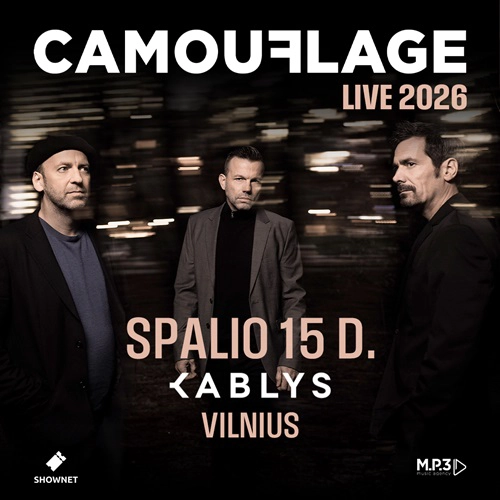
Camouflage Live 2026 | Vilnius
bilietai
Biplan - Lukiškių kalėjimas 2.0
bilietai
BI-2
kakava
EROS 2026
paysera
Backyard Presents: Rico Ace
kakava
BBNO$
allevents
Autobusas į „Pitbull“ koncertą Kaune iš Vilniaus
paysera
LOS SECRETOS DE PABLO 04.23 | VIENA NAKTIS ROJUJE | TAMSTA
paysera
PROCESŲ VALDYMO KONFERENCIJA 2026
Most popular events All Lithuania
ticketmarket
Vasaros festivalis “Grand Live Show’26” / 2 diena
allevents
Andrius Mamontovas su grupe „Geriausios dainos. I dalis“
kakava
PVŠ ROAST OF ARŪNAS VALINSKAS
bilietai
Pitbull - I'm Back! Papildomi bilietai
kakava
Monika Liu – Trakai
kakava
Evgenya Redko – Trakai
ticketmarket
Vasaros festivalis “Grand Live Show’26” / 1 diena
manobilietas
Marijonas Mikutavičius 360 / ŽALGIRIO ARENA
bilietai
Pitbull - I'm Back!
bilietai
SEL 50 | Kaunas 2026
 AllEvents.lt
info@allevents.lt
© 2023 - 2026, All rights reserved
AllEvents.lt
info@allevents.lt
© 2023 - 2026, All rights reserved